
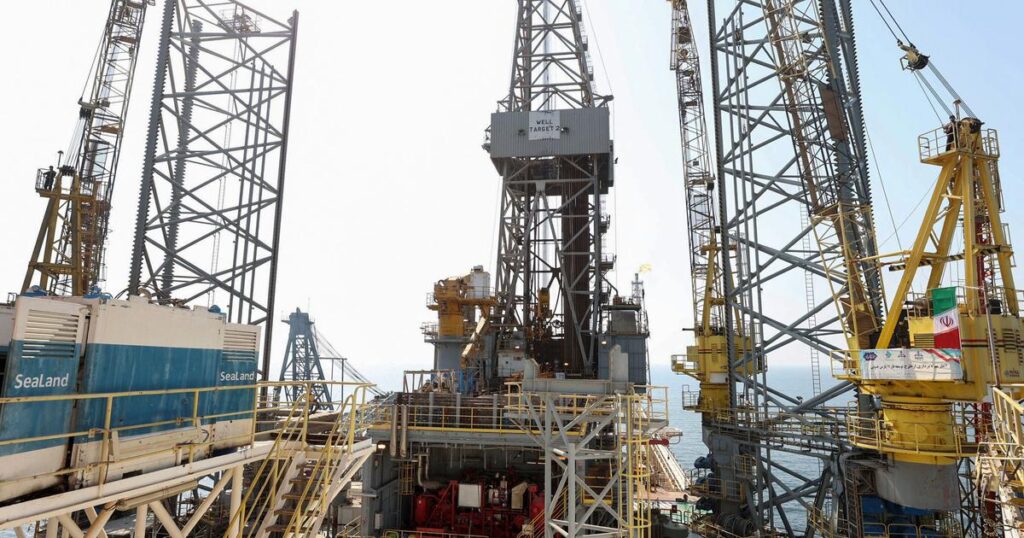
Iran has said that United States and Israeli strikes hit its South Pars natural gas field and associated infrastructure, Bloomberg reported on Wednesday.
Oil and petrochemical facilities in nearby Asaluyeh also came under attack, the news agency quoted Iranian state television as saying.
If confirmed, the attack marks the first time Iran’s upstream oil and gas facilities have been targeted since the conflict in West Asia began on February 28.
The field is shared with Qatar.
Here are more top updates from the conflict in West Asia:
- Shortly after South Pars and Asaluyeh came under attack, Tehran issued an evacuation warning for several oil facilities across Saudi Arabia, the United Arab Emirates and Qatar, saying they would be targeted by strikes “in the coming hours”, Reuters quoted Iranian state media as saying.
- The warning was directed at Saudi Arabia’s Samref Refinery and Jubail Petrochemical Complex, the United Arab Emirates’ Al Hosn Gas Field, and Qatar’s Mesaieed Petrochemical Complex, Mesaieed Holding Company and Ras Laffan Refinery. “These centres have become direct and legitimate targets and will be targeted in the coming hours,” the news agency quoted Iranian state media as saying. “Therefore, all citizens, residents, and employees are requested to immediately leave these areas and move to a safe distance without any delay.”
- Majed Al Ansari, Qatar’s Ministry of Foreign Affairs spokesperson, said that the “Israeli targeting of facilities linked to Iran’s South Pars field, an extension of Qatar’s North Field, is a dangerous & irresponsible step” amid the military escalation in the region. He added that targeting energy infrastructure constituted a “threat” to global energy security, as well as to the residents of the region and its environment. Ansari added: “We reiterate, as we have repeatedly emphasised, the necessity of avoiding the targeting of vital facilities.” He urged all parties to exercise restraint, adhere to international law and work toward de-escalation.
- Amid the development, benchmark Brent crude oil prices jumped above the $108 per barrel-mark, which was an increase of about $5.80 since Tuesday and $38 more than this time last year.
- The Israeli military on Wednesday claimed that it killed Iran’s Intelligence Minister Esmaeil Khatib in an airstrike in Tehran. Israeli Defense Minister Israel Katz was quoted as saying by The Times of Israel that “significant surprises are expected”. Tehran has not yet commented on the matter.
- Katz said on Wednesday that Israeli Prime Minister Benjamin Netanyahu has authorised the country’s military to “[eliminate] any senior Iranian figure…without the need for additional approval”.
- Indian citizens were among the 158 persons injured in the United Arab Emirates since the conflict started, the country’s defence minister said on Wednesday. The injuries ranged from minor to severe, the ministry added. Other than India, those injured were citizens of the United Arab Emirates, Egypt, Sudan, Ethiopia, the Philippines, Pakistan, Iran, Bangladesh, Sri Lanka, Azerbaijan, Yemen, Uganda, Eritrea, Lebanon, Afghanistan, Bahrain, Comoros, Turkey, Iraq, Nepal, Nigeria, Oman, Jordan, Palestine, Ghana, Indonesia, Sweden and Tunisia.
- The ministry also said that the attacks by Iran had killed two members of the Emirati armed forces. Six persons from Pakistan, Nepal, Bangladesh and Palestine had also been killed, Abu Dhabi added.
- The Emirati defence ministry said that it had engaged 327 ballistic missiles, 15 cruise missiles and nearly 1,700 drones launched by Iran since the conflict started. Thirteen ballistic missiles and 27 drones were engaged on Wednesday, it added.
- A part of the refineries in Iran’s Assaluyeh, linked to the South Pars gas field, was “hit by a projectile” by the Israeli-US forces on Wednesday, the country’s state-run news agency Tasnim quoted the deputy security officer of the Bushehr governor as saying.
- Around 90 ships, including oil tankers, have passed through the Strait of Hormuz since the conflict in West Asia broke out, AP quoted maritime and trade data platforms as saying. Global oil prices have continued to rise after the disruption.
- At least 89 ships, including 16 oil tankers, crossed the Strait of Hormuz between March 1 and 15, AP quoted maritime data firm Lloyd’s List Intelligence as saying. More than one-fifth of the ships were said to be Iran-affiliated, while several others are said to be Chinese and Greek-affiliated vessels. Some of the ships were reported to be “dark” transits, operating without location trackers to evade Western sanctions.
- India said last week that liquefied petroleum gas carriers Shivalik and Nanda Devi crossed the strait on Friday night and Saturday morning. A Pakistani-flagged crude oil tanker controlled by the Pakistan National Shipping Corporation also passed through the strait on Sunday, AP quoted Lloyd’s List Intelligence as saying.
- Tehran and Moscow claimed that a projectile struck the grounds of Iran’s Bushehr nuclear power plant on Tuesday, AP reported. Neither country said that there was any release of nuclear material in the incident.
- The International Atomic Energy Agency said that it had been informed by Iran that a projectile hit the Bushehr plant. No damage to the nuclear facility or injuries to staff were reported, the intergovernmental agency said. IAEA Director General Rafael M Grossi reiterated his call for maximum restraint during the conflict to avoid the risk of a nuclear accident.
- Iran on Tuesday fired cluster missiles at central Israel, describing the attack as “revenge” for the killing of its security chief Ali Larijani, Al Jazeera reported. The strikes in the Ramat Gan area near Tel Aviv killed two people. Iran’s Islamic Revolutionary Guard Corps said that the attack was in retaliation “for the blood of martyr Dr Ali Larijani and his companions”, Al Jazeera reported.
- Earlier on Wednesday, oil prices had fallen by more than $2 per barrel after the Iraqi government and Kurdish authorities in northern Iraq arrived at an agreement to resume oil exports through Turkey’s Ceyhan port, Reuters reported. Brent futures fell by 2.1% to $101.1 on Wednesday, after rising by more than 3% on the previous day. However, Brent futures have settled over $100 a barrel for the last four sessions on account of the conflict in West Asia.
- The United States said that it dropped several 5,000 pound or 2,250 kg of bombs on Iranian missile sites near the Strait of Hormuz, AFP reported. The US Central Command said that the sites posed a threat to international shipping.
- Israel’s health ministry said that 3,272 persons have been injured and taken to hospitals since the conflict began. Currently, 74 persons are hospitalised, out of whom seven are in a serious condition, the health ministry said.
The US and Israel launched an attack on the Iranian government on February 28, claiming that Tehran’s action posed an existential threat to Israel. Washington acts as a guarantor of Israel’s security. Iran has retaliated by striking Israel and US military bases in the region, and targeting major cities in Gulf countries and some ships.
Israel has been claiming that Iran is close to obtaining a nuclear weapon, which could alter the regional security balance. Tehran has long maintained that its nuclear programme is for civilian purposes.
Since the start of the conflict, Iran has effectively blocked the Strait of Hormuz for most international commercial vessels. About 20% of global petroleum supply passes through the maritime chokepoint.
The International Energy Agency has said that the fighting has caused the “largest supply disruption in the history of the global oil market”.